The MWRD North Branch Pumping Station is a historic, 100-year-old wastewater facility that has experienced significant deterioration over time. Path Construction is performing a structural rehabilitation focused on partially or fully replacing large portions of the existing concrete structure and installing new architectural masonry that restores the building to its original appearance. While the finished facility will present a renewed exterior, the primary objective is structural performance and long-term operational reliability.
Drivers for Rehabilitation
The work was driven by widespread and visible structural degradation. Much of the existing concrete had deteriorated to the point where replacement was required. Although the aesthetic improvements will be noticeable, the majority of the effort is focused on restoring the structural integrity of this critical wastewater infrastructure facility rather than cosmetic upgrades.
Client and Oversight
The Metropolitan Water Reclamation District is the sole client and serves as both owner and architect. Every aspect of the work requires their review and approval. This has significantly influenced construction execution, as many design decisions present constructability challenges. Specifications and design notes often limit available solutions, creating frequent constraints that require constant problem-solving and unconventional approaches, especially given the access limitations associated with working along the North Branch of the Chicago River.

Technical Scope of Work
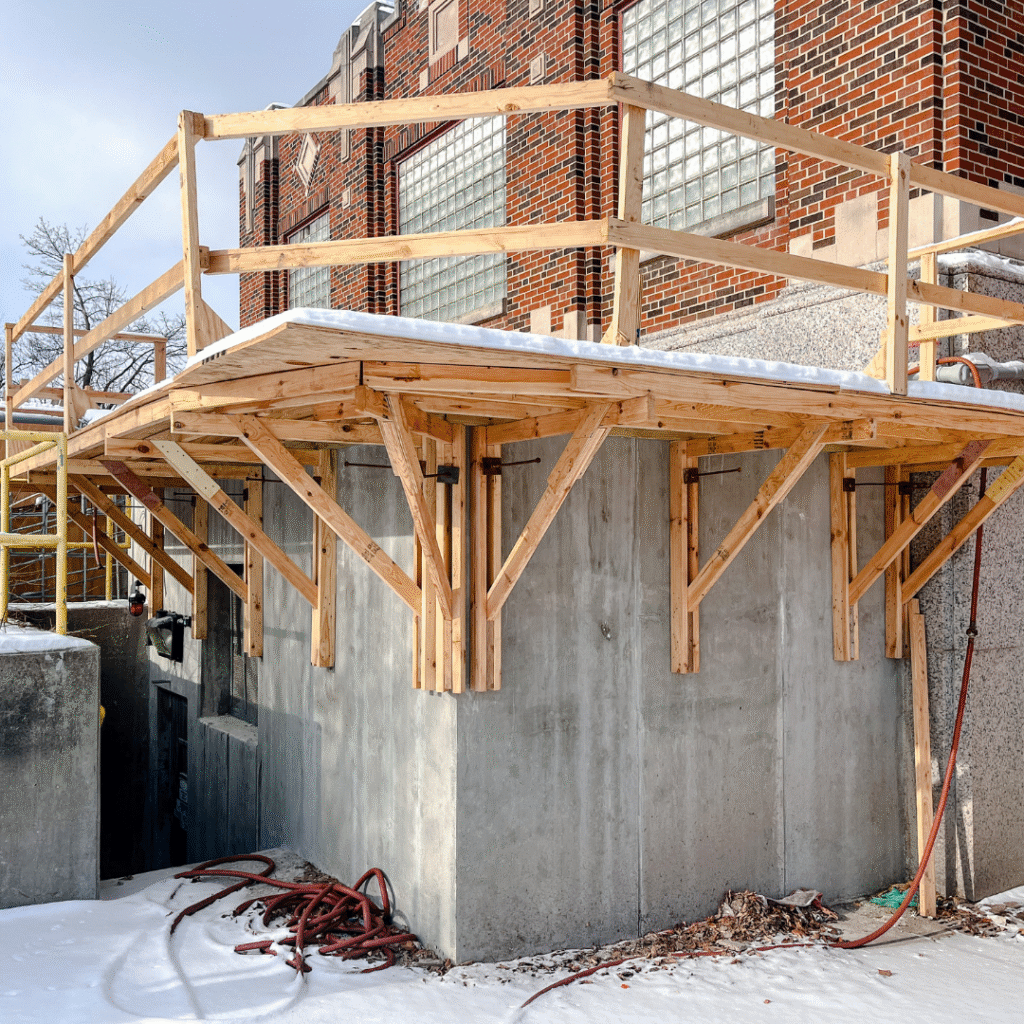
The rehabilitation scope includes partial-depth repairs to all exterior concrete walls, effectively refacing the structure. The project also involves replacement of the cantilevered boat dock and staircase that extend over the river, as well as replacement of elevated concrete slabs located above the storm discharge pumps. Each scope item requires extensive structural engineering, evaluation, and approval prior to execution.
Site Constraints and Operations
The North Branch River presents the largest site constraint. Multiple phases of work require dive crews and boom lifts staged on barges. Because portions of the work occur within the treatment plant’s water systems, specialized professional divers are required. With water temperatures ranging from 30 to 40 degrees, Chicago’s winter conditions have not slowed progress.

The pumping station remains active throughout construction and functions as an overflow facility during rain events. Crews must continuously monitor weather conditions and coordinate with MWRD regarding tunnel and reservoir operations.
Lockout-tagout procedures are required whenever work occurs in or over the river, and emergency responses have occasionally been necessary during overnight storm events.
Access to the site is also challenging. The facility sits on a vaulted structure directly above a twin sewer, resulting in severe loading restrictions. Its location on a one-way street surrounded by tight residential roads further complicates deliveries and equipment movement.
Sequencing, Schedule, and Logistics
The project has an overall duration of approximately 2.5 years. Sequencing has had the greatest impact on the schedule, as the structure must be evaluated at each phase before advancing. Careful planning is required to identify work that can be completed ahead of future phases without compromising structural stability or ongoing operations.
Safety, Quality, and Progress
Fall protection is critical due to the elevated deck work, and extensive training is required for subcontractors working near or over water. Quality control is managed in direct coordination with the Resident Engineer assigned to the project.
To date, approximately 80 percent of the exterior wall repairs have been completed, and the existing boat dock has been fully demolished. Once finished, the pumping station will be structurally stable, operationally improved, and capable of continuing its role in protecting Chicago neighborhoods during major storm events.